
3rd Grade: INTRO TO PUBERTY_sandbox
INTRO TO PUBERTY – TEACHER NOTES
HOW TO USE THESE TEACHER NOTES
Description of this Class for Parents + Caregivers
Description of this Class for Parents + Caregivers — Español
INTRO FOR EDUCATORS
By third grade, many students are entering the very early stages of puberty––if they’re not, they’re almost certainly beginning to notice changes in their peers. For some, this might show up as new curves or greasier skin or body odors. This wide range of shifts can lead to comparisons and sometimes even worry that some kids are far ahead, lagging behind, or just plain different from others.
Research shows that puberty starts earlier than it did when many of today’s parents were growing up. What used to begin around age 11 for many now starts, on average, between 8-10… but is also completely “normal” if puberty doesn’t appear until 12 or 13. This age disparity is confusing, both intellectually and practically: one third grader who is navigating new hygiene needs might very well sit next to a classmate whose body hasn’t begun changing at all.
Perhaps the most important point for students to learn in this lesson is that there is no single “right” timeline for puberty. Everyone has their own path: when it will start, what will transform first, how long the process will last, and what things will look like when it’s done.
Some science basics for those who would like a refresher: Puberty is the path to reproductive maturity. Before it begins, a person cannot be part of a baby-making equation; but by the time it is finished they (potentially) can. The puberty process is slow, lasting 8-10 years for many. It starts when a gland in the brain signals the body to begin producing sex hormones––ovaries make estrogen and progesterone, while testicles make testosterone. These hormones influence maturation of the reproductive system, physical growth, and emotional responses, too.
Now to add on the developmental piece: third graders are curious, socially sensitive, and just beginning to understand privacy and personal boundaries in new ways. This explains why they may start whispering about who’s taller, who smells different, or who needs a bra. Without structured conversation, this curiosity can quickly turn into teasing or misinformation.
This lesson introduces puberty at a level that is age-appropriate, reassuring, and practical. It frames puberty as a shared human experience—something everyone goes through, just on different schedules—to reduce shame and create space for respectful dialogue. Students learn that:
- Puberty is part of growing up.
- Everyone changes in both similar and different ways.
- Puberty starts earlier for some kids and later for others.
- Curiosity is okay, but comments about someone else’s body are not respectful.
- Trusted adults are the right people to go to with questions.
The goal is not to provide every detail of puberty––there are lessons throughout the later grades of That Health Class curriculum that circle back to the topic with more detail––but rather to lay a foundation of knowledge, empathy, and respect. When students know what to expect, they are less likely to feel anxious about their own timeline and more likely to show kindness to peers who are growing at a different pace.
A note about the term “private parts” versus using anatomically-correct language: Research is clear that when kids know the names of their anatomical parts––including their “private” parts––they are safer and healthier. Specifically, their risk of victimization by sexual predators goes down. It is considered best practices to use anatomically accurate vocabulary in teaching health education at any age and therefore, in this curriculum, we introduce in the teacher notes the anatomical names for the genitalia for the first time in Kindergarten; the terms are more formally integrated into the teaching starting in 3rd grade. For a variety of reasons, schools may choose to introduce the terminology sooner or later. However, if you are looking for an article to explain why naming these parts is important, here’s a short article from Psychology Today, an article from Nationwide Children’s, and this one from the American Academy of Pediatrics. There’s more about this in the “BODY PARTS THAT CHANGE + GROW DURING PUBERTY” section below as well.
For more about the increasingly early start of puberty, you can read this New York Times article or this piece from CNN or watch this video clip. If you want more information, listen to this episode of the This Is So Awkward podcast: Dr. Louise Greenspan on Puberty's Dramatic Shift: Earlier but Not Faster
Here are the learning objectives for this lesson:
- Understand what puberty is, that it’s a normal part of growing up, and it happens at different times for everyone.
- Identify some early physical and emotional changes that may happen during puberty.
- Practice respectful ways to talk (or not talk) about body changes.
- Recognize the difference between curiosity and disrespect.
- Build confidence in responding to comments with clarity and self-respect.
Here are the activities that go with this lesson–– you can incorporate them into the teaching (they’re also linked in the corresponding section below) OR use them at the end to reinforce the concepts.
ICE BREAKER
What’s something you've been curious about when it comes to growing up?
Teacher note: Let students give examples. Use this discussion to normalize all kinds of growth, not just physical or hormonal.
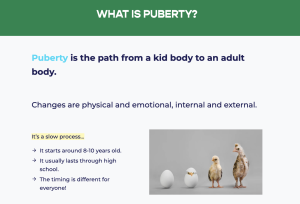
WHAT IS PUBERTY
Puberty is the word for how the body shifts from being a kid to being an adult. It includes changes inside and outside of the body.
- It’s slow! Most people start seeing changes between the ages of 8-10, but some won’t see anything happening until they are 12 or 13. Everyone is on their own timeline.
- It lasts many years. For some kids, it can last 10 years and finish after high school. Everyone is on a different timeline.
- It starts in the brain. The brain sends hormones to the body to tell some of the internal organs to mature and others––like muscles and curves––to grow.
- It’s physical and emotional. The physical changes include growing taller and making body odor. The emotional changes include mood swings and a desire for more privacy.
Teacher note: If you have a class that is ready to dive deeper into the changes that come with puberty, look at these lessons in older grades: BODY CHANGES FOR EVERYONE (4th grade) and TIMELINE FOR BODY CHANGES (6th grade). For more about the emotional changes that go along with puberty, look at the HANDLING BIG EMOTIONS lesson (3rd grade).
EVERYONE GOES THROUGH PUBERTY
Everyone goes through puberty and everyone’s body changes at some point. Kids can’t control when or how it will happen––the hormones are in charge.
Puberty doesn’t start for everyone at exactly the same time. And it doesn’t end for everyone at exactly the same time, either.
- Changes happen in a different order for different people.
- Some people notice physical changes first––like new lumps, bumps, and curves.
- Some notice emotional changes first––like mood swings.
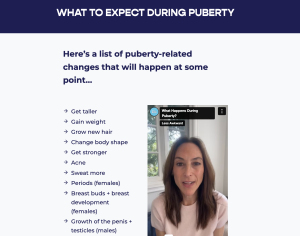
WHAT TO EXPECT DURING PUBERTY
Here’s a list of puberty-related changes that will happen at some point…
- Get taller
- Sweat more
- Gain weight
- Grow new hair
- Change body shape
- Get stronger
- Acne
- For females, breast buds and breast development and periods
- For males, growth of the penis + testicles
- Deepening voice (more for boys than girls, but happens to both!)
Watch this two and a half minute video from Dr. Cara Natterson to learn what to expect during puberty.
BODY PARTS THAT CHANGE + GROW DURING PUBERTY
Teacher note: This section covers the anatomical names for private parts and briefly explains how they change during puberty. Research shows that knowing the anatomically correct names and functions of body parts helps keep kids safe and healthy. Specifically, body knowledge helps:
- Enable open conversation about bodies
- Facilitate communication about physical concerns
- Promote bodily autonomy
- Provide a sense of personal agency
- Ease getting help from trusted adults
All of these skills become especially important during puberty when bodies change.
For more information on why sharing this information matters, check out this article from Nationwide Children’s or this one from the American Academy of Pediatrics. For more detailed information on the reproductive organs, check out the 5th grade lessons MALE ANATOMY 101 and FEMALE ANATOMY 101. Open the PDFs linked to the right for anatomical diagrams, not for use in class, but for your reference - Female Anatomy Diagrams and Male Anatomy Diagrams.
In addition to the voice dropping, new hair growing, and bones getting longer during puberty, the private parts start to grow and change. It happens to everyone and doesn’t have to be embarrassing, although it might feel that way at first.
It can feel awkward for everyone involved to talk about body parts, particularly the genitals and reproductive organs, but knowing the correct language for these parts helps keep everyone safe and healthy.
External male parts:
- Penis - This organ hangs outside of the body below the pelvis—it’s made up of a long narrow shaft and a tip (called the “head” or the “glans”).
- Urethral opening - The urethra is the tube that carries urine (pee) and semen (a mix of sperm + bodily fluids) out of the body. The hole at the tip of the penis is the urethral opening.
- Testicles - These two egg-shaped balls hang below the pelvis, inside the scrotal sac. This is where sperm and testosterone are made.
- Scrotum - The sac that covers and holds both of the testicles outside of the body.
External female parts:
- Vulva: this includes all of the external female genitalia: the labia, clitoris, urethra, and vaginal opening.
- Urethral opening: where urine (pee) comes out.
- Vaginal opening: where a baby can come out.
- Vagina: this is a muscle shaped like a tube that’s mostly inside the body (except the vaginal opening which can be seen from the outside).
- Labia: the skin folds outside of the vaginal opening (also referred to as “lips”)
- Clitoris: a small, sensitive bump where the labia come together.
- Breasts:* When breasts start to grow, they slowly change size and shape; the nipple on top also changes color and texture.
*Teacher note about breasts: Regardless of gender, all humans have breast tissue. But without estrogen stimulation, breasts won’t develop. Half of all males have enough estrogen in their bodies to experience some breast growth during puberty; it’s usually limited to breast budding, and the buds generally flatten down again (medical term: involute) after a few months. When males have breast growth, it’s called gynecomastia. Sometimes it happens on one side, sometimes both. Any person nervous about breast growth should speak to a healthcare provider. There’s also lots of information about breast growth + development in the Hub.
CURIOSITY IS NORMAL… AND HAS BOUNDARIES
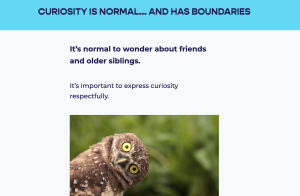
Some kids will be excited about the changes that come with puberty, some will be anxious, and some will be embarrassed. And most will be a combination of all three! Students’ curiosity may stretch beyond themselves to wonder about friends and even older siblings.
- Curiosity is a great trait––it shows people you are interested.
- But it can take some learning to express curiosity with respect.
- You can be curious and kind at the same time. It’s important to use respectful language (no joking, teasing, or whispering about someone’s body).
- Remember: curiosity is for understanding, not for teasing or comparing.
- It’s best to ask questions about private things to adults, not other kids.
Ask: What are some ways you can be curious, kind, and respectful if you have a question about your growing body?
To help the discussion, offer these examples:
- When will I start growing taller? (Not: WOW! You sure shot up!)
- Why do people use deodorant/ (Not: Do you have armpit hair yet?)
- Is it normal to feel moody? (Not: Why are you such a crank lately?)
- Why do some kids grow faster than others? (Not: Why does your body look like that?)
Teacher note: Curiosity isn’t a bad thing! But it can feel vulnerable, especially around how bodies are growing or are shaped. Keep in mind that the idea of the activity that follows is to include ways to show curiosity without being disrespectful.
ACTIVITY: CURIOUS OR CROSSING A LINE?
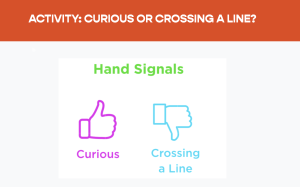
The “Curious or Crossing a Line?” activity helps students practice telling the difference between questions or comments that show healthy curiosity and those that go too far and cross a line. Open the PDF to the right for directions on how to lead this activity - Curious or Crossing a Line?
WHEN SOMEONE CROSSES YOUR BOUNDARY
As kids go through puberty, they will have a lot of feelings. These vary from person to person, and one person’s feelings will change over time as well. These feelings can even change day to day. They include:
- Excitement about a particular change.
- Awkwardness about another.
- Frustration about being earlier or later than other people.
- Worry about a new lump or bump.
- Nervousness about how your body will wind up looking when puberty is done.
ACTIVITY: BOUNDARY BUSTERS
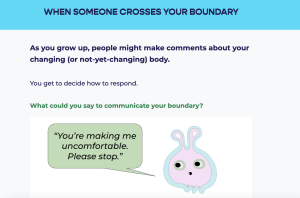
The “Boundary Busters” brainstorming activity is designed to help students prepare for unwanted or uncomfortable comments about their bodies and gives them the words to use when someone crosses a boundary. Open the PDF to the right for directions on how to lead this activity - Boundary Busters
SUMMARY
Everyone goes through puberty, but not at the same time. When you talk about it, be kind and don’t tease. And treat yourself with respect, too.
LET’S TALK ABOUT IT:
Ask:
- What’s one way you might know that puberty is starting?
- What’s one to tell if someone has crossed a line?
- What are some things you can say when you feel uncomfortable?