
4th grade: HYGIENE_sandbox
Description of this Class for Parents and Caregivers
HYGIENE – TEACHER NOTES
Teacher notes are designed to supplement lessons throughout That Health Class. The goal of these notes is to offer basic background information on the topic for educators who have less experience with the subject matter and to offer a deeper dive into biology, physiology, and data for experienced educators craving more information. Here’s how the teacher notes are organized:
- INTRO FOR EDUCATORS: This is not information to be presented in class, but rather sets the stage for why this content is relevant and, in some cases, how the information has changed over time. It also includes an episode from the This Is So Awkward podcast for even more information on the topic.
- TEACHING POINTS: These always begin with an ice breaker and set of learning objectives, followed by the substance of the lesson, organized with the corresponding slide at the start of that section of the notes. When there are PDFs describing in-class exercises, links will appear both in the relevant section and also at the very top of this document.
- LET’S TALK ABOUT IT: Offers conversation starters to solidify learning at the end of each class or can serve as an exit ticket if needed.
For more information on any given lesson across the entire That Health Class curriculum, we encourage you to login to the Less Awkward Hub or search the Resource We Love list.
INTRO FOR EDUCATORS
As kids enter the tween years, their need for good hygiene escalates big time! This is largely thanks to a process called adrenarche, which triggers the release of hormones like DHEA and DHEAS which, in turn, cause increased sweat production and higher oil concentration inside that sweat in certain parts of the body (scalp, face, armpits, groin, and feet, to name a few).
More sweat and oilier sweat translate into 2 very predictable phenomena: body odor and acne. The hormones released in adrenarche also tell hair follicles to grow more hair, and that hair can be darker, thicker, curlier, or all of the above. Hair + zits + BO deeply impact social dynamics and self-esteem.
This lesson doesn't get into adrenarche (you can find that in the lesson about HAIR CARE), but the background helps educators understand what's underlying the changes you are seeing––and smelling––in your classrooms. What this lesson does do is to explain the fundamentals of hygiene so that kids can take better care of their bodies. It's the first pass at this concept, which gets repeated in many different ways (and with lots of scientific explanations for students) throughout That Health Class.
Kids can implement hygiene basics when they understand the why behind these strategies. Good hygiene has been shown to impact health, well-being, and confidence. For more articles on the topic, take a peek at these: Smells Like Tweens and Teens from Children's Wisconsin; Body Odor in Kids & Teens from HealthyChildren.org; Hygiene Basics from Teens Health (this one can be read by teens and lots of tweens, too); and Here's Why Teen's Body Odor Can Be Especially Strong from Science News Explores.
Want a deeper dive? Listen to the This Is So Awkward podcast episode about hygiene.

ICE BREAKER
Have you noticed people around you starting to smell different? Or that you make new smells and no one else seems to?

LEARNING OBJECTIVES
- Understand the variety of meanings of the word hygiene.
- Learn the different ways people keep their bodies clean.
- Recognize why good hygiene matters in the short term and in the long run.

HYGIENE INTRO
It’s important for people to understand the connection between hygiene and wellness. Being clean leads to better health. Take, for example, hand washing. Here's why washing hands makes people healthier:
- Washing hands keeps bacteria and viruses off of hands and fingers.
- This means that when we eat, those organisms don’t get onto our food and into our mouth (think about picking up a sandwich or licking your fingers after eating chips).
- Also, separate from eating, hands and fingers often end up rubbing eyes, picking noses, or inside the mouth (nail biting!).
- If hands and fingers are germ-covered, those bacteria or viruses travel inside the body.
It turns out, good hygiene benefits more than physical health––it can also change a person’s social experiences. Self-esteem and self-confidence can be hard to come by some days, especially when the body is shifting and changing.
- The way a person smells can affect how they're treated by others.
- There's also a direct connection between how well someone takes care of themself (hygiene) and how they feel about themself (self-esteem).
Cleaning the body, washing hair, and brushing teeth show others that you respect your body enough to take good care of it. People who take better care of themselves often report feeling better. This actually changes their body language – they might smile more or stand up straighter.
Class conversation: One helpful way to open up the conversation about hygiene is to ask questions about how people react to it. You can try prompts like: Have you ever noticed people keeping their distance from someone with bad breath? How about how people react when someone has strong body odor?
Class exercise: Take a minute to have the class use body language to illustrate the difference between confidence and lack of confidence. Have students change their posture, the way they hold their heads + shoulders, and where they focus their gaze based upon feeling confident or insecure.

HYGIENE: FACE
Washing the face twice a day removes dirt and oils. This is important because it minimizes irritation and unplugs pores. Both of these things reduce the likelihood of acne (which kids often refer to as zits, so you can too!). Here's how it works:
- Washing clears away the bacteria that live on the skin.
- It also helps to unplug the skin’s pores.
- Plugged pores can collect oil, which is a great breeding ground for the bacteria.
- It's the combination of oil + bacteria that causes acne, so washing these things away helps to prevent it.
- PRO TIP: many kids will get pimples even if they wash their face regularly... but it does reduce the amount of clogging and the load of bacteria.
Teacher note: There’s an entire lesson about SKIN CARE in the 6th grade course list if you're looking for more information. Or, if you’re interested in learning more about pimple formation, here’s a Puberty Podcast episode that explains it all in a very amusing way.
HYGIENE: TEETH
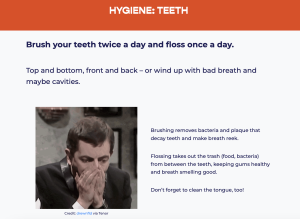
There’s a reason we tell kids (and adults!) to brush teeth twice a day... and this means brushing top and bottom, front and back. There's also good reason why every single dentist on earth recommends flossing once a day:
- Brushing removes bacteria and plaque.
- These are the underlying causes of tooth decay teeth and gum disease.
- Bacteria also make the breath smell.
- This is similar to the way body odor works (described below).
- Brushing the tongue is key here, too.
- Flossing removes the food and bacteria from between the teeth––basically, this takes out the garbage between the teeth.
- Flossing keeps gums healthy and further reduces the bacteria load, improving breath.
If you have an extra 4 minutes, watch this video from SciShow Kids to learn why we brush our teeth.

HYGIENE: BODY
Many kids don’t realize that bathing, showering, or sponge bathing once a day is key to basic hygiene. BUT IT MUST INVOLVE SOAP! Even the ones who know to do it daily don't always think soap is super important...
Here's why water alone does NOT do the trick: soap (not water) surrounds the dirt and oil, which then allows it to lift off of the skin’s surface.Lathering up with soap removes dirt, germs, and irritants that otherwise pile up on the skin. All kids should be encouraged to focus on the sweatier, smellier spots like underarms, feet and groin area when washing the body. Here’s the 30 second explainer video embedded in the slide: Why You Need to Use Soap in the Shower.
Some skin types cannot tolerate washing and drying every day––this is why sponge bathing may be recommended for them. (For kids who don't know, sponge bathing basically refers to using a soapy washcloth to wash the armpits, neck, feet, and groin, and then rinsing and drying.)
Some skin types cannot tolerate scented or colored soaps. They can be so irritating, they can actually create rashes or exacerbate acne. If kids are looking for advice, steer clear of mentioning specific brands but it's always helpful for them to know that products with no colors, dyes, or scents are the way to go.
What about hair washing frequency? Like soap on the body, different scalps tolerate different frequencies of shampooing. Some people need to do it every day, some once a week, and lots of people fall in between.
For those with time to share, this is an excellent 4 minute video from TedEd: What Causes Body Odor?

HYGIENE: SKIN CARE
Washing the face dries it out. In fact, so do many of the products used by kids to ward off pimples. Drying products counteract the oils on the skin at first… but then the oil glands beneath the skin’s surface sense the arid conditions and increase their oil production. So, over-dried skin can actually become greasy.
This is why it’s important to moisturize the skin, even when that feels counterintuitive:
- Dried-out skin can split, itch, rash or even break out.
- Pimples form when dry skin tries to moisturize itself and it produces extra oil.
- Oily skin that is repeatedly stripped of its surface oils needs a cue to stop producing more grease.
Daytime moisturizers should have sunscreen! Kids don’t typically respond to worries about skin cancers, but tell them that SPF prevents wrinkles (which it does) and they’re more likely to comply. Color-free and perfume-free products are usually the least irritating… that said, avoid ones that sting, even if they are perfume- and color-free.
Fun fact: Ask students if they know the difference is between the skin on a 90-year old’s bottom and their face? The answer: wrinkles. Why?: because the bottom doesn't get exposed to the sun.
HYGIENE: FEET:
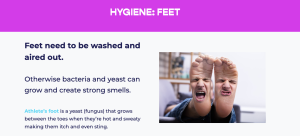
Feet need washing and airing out, or bacteria and yeast can grow.
- Bacteria on the feet can create strong smells.
- “Athlete’s foot” is a yeast (fungus) that grows between the toes when they’re hot and sweaty. Sometimes the only symptom is itching or stinging. Sometimes there's lots of faking either between the toes or along the bottom of the foot (or both).
HYGIENE MYTH #1: WASHING
The following 3 slides cover the things we should not to do as part of hygiene.
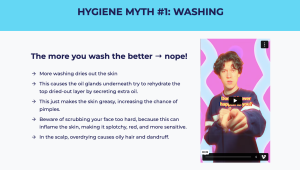
Myth 1: The more you wash the better → nope! When frequent washing dries out the skin, the oil glands underneath try to rehydrate the top dried-out layer by secreting extra oil, making the skin greasy and increasing the chance of pimples. There’s lots more information about acne in the 6th grade SKIN CARE lesson.
Quick summary here: the pore appears as a tiny hole in the skin’s surface, but it’s really a deeper, flask-shaped structure with a hair follicle and an oil gland – it’s long narrow neck can get clogged with oil and bacteria, creating a bump, either white, red, lack, or some combination.
Scrubbing the face too hard can inflame the skin. This makes it splotchy, red, and more sensitive.
In the scalp, over-drying causes oily hair and dandruff.
Here’s the 1 minute video embedded in this slide: 1-800-DAN-DRUFF

HYGIENE MYTH #2: PIMPLES
Myth 2: Picking a pimple makes it heal faster → nope! Quite the opposite!
Picking may open up the clogged pore and release white blood cells (the whitehead), but it also opens a bigger hole on the skin. Bacteria that normally live on the skin (as part of the microbiome) can climb down into the pore and multiply, making pimples worse. Picking causes more inflammation. This can make the area even more red and swollen.
In addition to the video that accompanies the text in the slide deck (Don’t Pick Your Face), scroll to the bottom of this link for this 3 min video: Is There a Pimple Cure?

HYGIENE MYTH #3: TEETH
Myth 3: No one notices when you don’t brush your teeth → you wish! In a non-shaming way, it’s important to teach kids how people perceive them when they opt out of hygiene routines.
The mouth is a bacteria breeding ground. It’s those bacteria that make the breath stink. Brushing and flossing are the only ways they get cleaned out.
Have an extra 4 minutes? Watch this TED-Ed Video on What Causes Bad Breath?

SUMMARY
“Hygiene” is the list of activities people can (and should!) do regularly to keep the body healthy. Good hygiene usually makes people feel more confident, too!
We’ve included a 1 minute video that runs through hygiene best practices: How Often Should… Hygiene Summary

LET'S TALK ABOUT IT
"Pick one thing you thought you knew about hygiene/body care that didn't turn out to be true."
- Where did you get the (wrong) information in the first place?
- Where might you turn now?
- How can you tell what or who are trusted resources?

SCENARIO
Addison noticed that Robbie started to have strong body odor and wanted to tell him to start showering more often and using deodorant, but didn't want to hurt his feelings. What would it sound like if Addison told Robbie in an unkind way that might make him feel ashamed? What would it sound like for Addison to tell Robbie in a supportive way that might not feel too embarrassing?