
EFFECTIVE COMMUNICATION SKILLS_sandbox
EFFECTIVE COMMUNICATION SKILLS — TEACHER NOTES
HOW TO USE THESE TEACHER NOTES
Description of this Class for Parents + Caregivers
Description of this Class for Parents + Caregivers — Español
Activity 1: How Was Your Day - An Active Listening Exercise
Activity 2: Practicing Apologizing
Activity 3: How to Write a Professional Email
Teacher notes are designed to supplement the slide deck for lessons throughout That Health Class. The goal of these supplemental notes is twofold:
- To offer basic background information on the topic for educators
- To offer a deeper dive into biology, physiology, and data for educators craving more information
Here’s how the teacher notes are organized:
At the start of each set of notes is a general INTRO FOR EDUCATORS – this information does not have a corresponding slide, but instead sets the stage for why this class is relevant and, in some cases, how the information has changed over time. It also includes an episode from the This Is So Awkward podcast that includes even more information on the topic.
Then follows a description of every slide in the deck. You will see thumbnail images of each slide, followed by detailed definitions and explanations of the text and/or videos included. Some sections contain links to PDFs containing examples and ideas for in-class exercises. These corresponding PDFs are also linked at the top of this document, just below the class description.
The LET’S TALK ABOUT IT section concluding each slide deck is meant to start conversations. It can be a jumping off point for wrapping up class discussions or can serve as an exit ticket if needed.
For more information on any given lesson across the entire That Health Class curriculum, we encourage you to login to the Less Awkward Hub or search the Resource We Love list.
INTRO FOR EDUCATORS:
It is no secret that healthy relationships are built on a foundation of communication. This lesson covers everything from respectful expression of emotion to active listening to reading body language. Effective communication is all about clearly sharing one’s own perspective while also understanding and empathizing with others. Developing these skills in adolescence sets teens up for success in all types of relationships throughout their entire lives.
If you’re looking for a This Is So Awkward podcast episode that connects with this lesson, The Family Chat and Messing Up are particularly fun ones.
ICE BREAKER
Have you ever had to repeat an apology “like you mean it”? How can you tell if an apology is genuine or not? Are there other ways to show you’re sorry without saying “I’m sorry?”
LEARNING OBJECTIVES:
- Understand the importance of communication in relationships.
- Identify elements of effective + ineffective communication.
- Learn how to communicate through conflict and apologize genuinely.
- Consider the role of nonverbal + digital communication.
- Practice effective communication skills.
COMMUNICATION IS KEY
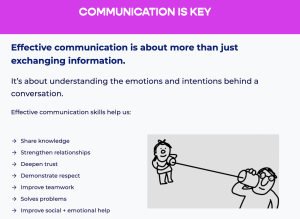
Effective communication is about more than just exchanging information; it’s about cultivating a relationship and understanding the emotions and intentions behind a conversation.
Communication is a huge part of our lives, and effective communication skills are crucial in all kinds of relationships. They help us:
- Share knowledge
- Strengthen relationships
- Deepen Trust
- Demonstrate respect
- Improve teamwork
- Solve problems
- Improve social + emotional health
Here are some practical ways that communication changes our lived experiences:
- Making plans with friends
- Negotiating phone rules with a parent
- Asking a teacher for an extension on a homework assignment
- Interviewing for a job
- Asking somebody out on a date
INEFFECTIVE COMMUNICATION
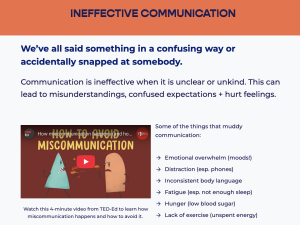
Everyone messes up communication from time to time: wording something in a confusing way, contradicting ourselves, using passive aggression, or accidentally snapping at somebody. These are all examples of ineffective communication. Communication is ineffective when it is unclear or unkind.
Ineffective communication can cause misunderstandings and hurt feelings in relationships. It can create confusing expectations that leave a person disappointed, hurt, or insecure.
Here are some things that commonly get in the way of effective communication:
- Feeling emotionally overwhelmed: Said another way – moods! When a person feels emotionally out-of-control, they are more likely to blow up or sulk or go silent but send confusing nonverbal signals. Example: snapping at a sibling while stressed studying for a test.
- Distraction: Especially by devices. When people multitask, check their phone during a conversation, or even just zone out trying to think about what they’re going to say next, the lack of focus impacts their ability to communicate effectively. Example: Checking the score of a game while a friend is trying to set a plan – it’s impossible to focus on both and you’ll probably have to ask the friend to repeat the info, which may frustrate them.
- Inconsistent body language: When the mouth says one thing, but body language says something else, this causes confusion or suspicion. Example: “Yes of course!” in response to a question, but said with arms crossed and an eye roll.
- Fatigue: Especially thanks to not enough sleep! Moods are reset with deep sleep, so without it, the next day tends to be emotionally rocky.
- Hunger or lack of exercise: low blood sugar or unspent energy can land in the same place – feeling off. And that, in turn, can mess with communication style. Example: There was no time to eat lunch at school and then, as soon as you get home, your mom launches into 20 questions… the result: you’re hangry!
Watch this 5 minute TED-Ed video to learn how miscommunication happens (also embedded in the slide).
EFFECTIVE COMMUNICATION
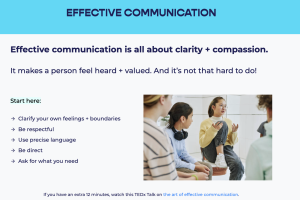
If ineffective communication leaves a person feeling unheard and undervalued, effective communication does the opposite. Effective communication is characterized by clarity and compassion.
Here are some strategies to communicate more effectively:
- Get clear about your own feelings and boundaries. Pro tip: write down thoughts and feelings before a difficult conversation to clarify emotions and articulate them more clearly.
- Be respectful. Be kind, direct, and treat others the way you would want to be treated.
- Use precise language. The clearer you can be about your feelings and expectations, the more likely you are to be understood. For example, saying “I am disappointed in myself for not playing my best at the soccer game last night” is much clearer than “I’m sad,” silence, or a slammed door.
- Ask for what you need. Because people aren’t mind readers!
If you have an extra 12 minutes, watch this TEDx Talk on the art of effective communication (also linked in the slide).
ACTIVE LISTENING
When it comes to communication, how we listen is just as—if not more—important than how we speak. Active listening requires more than just hearing the words being shared. It involves engaging with the emotions and information that the speaker is trying to convey. If you don’t understand what they’re trying to communicate – ask. That’s a big part of active listening, too.
When you practice active listening, not only will you have a better understanding of the situation, but you will also help make the speaker feel heard and understood, which can help build trust and strengthen your connection.
Watch this 8 minute video from Harvard Business Review to learn more about the art of active listening (it is embedded in the slide).
ACTIVE LISTENING DOs + DON’Ts
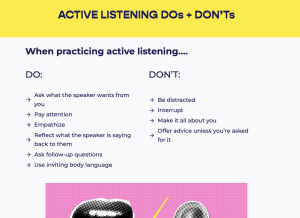
When practicing active listening…
DO:
- Ask yourself what the speaker wants from you. Are they looking for advice? Somebody to listen to them? Something else? Getting clear about expectations for the conversation up front can smooth communication.
- Pay attention when others are talking. Make eye contact and pay attention to pauses, tone of voice, and body language for deeper understanding.
- Empathize. Saying something like “that sounds really hard” or “You must be so excited!” shows that you understand and empathize with the person’s situation. Try to set aside judgement and understand their perspective, even if you have a different opinion.
- Reflect what someone is saying back to them. Saying something like, “it sounds like you are feeling frustrated at your mom” demonstrates that you understand what the person is going through and provides an opportunity for them to affirm or clarify what they’re feeling.
- Ask questions. Asking relevant questions shows that you are paying attention and care about the person. It also helps you gather more information.
- Use inviting body language. Turning towards the person, having relaxed posture, smiling, and nodding occasionally are all ways to show that you are listening. Encouraging the speaker to continue talking with occasional comments like “uh huh,” indicate that you’re not in a rush and that you are really interested in what they have to say.
DON’T:
- Don’t be distracted. If you are thinking about something else or multitasking (e.g. looking at your phone), the other person might not feel like you’re really hearing what they have to say and that you don’t care
- Interrupt. Interrupting is rude and may make the other person feel like what they have to say doesn’t matter.
- Make it all about you. Active listening is about making the other person feel heard and understood. Sharing from personal experience can be helpful, but if you jump in right away, unprompted with “this reminds me of a time when I…”, the speaker might feel steamrolled. Listening is not the same thing as waiting your turn to talk.
- Offer advice unless you are asked for it. Sometimes people just need to vent. Avoid offering your opinion on the situation unless the person asks for it.
If you have an extra 5 minutes, watch this video from TED-Ed to learn about active listening (also linked in the slide)
Activity: Open the PDF linked to the right for instructions on how to lead a short active listening exercise - How Was Your Day - An Active Listening Exercise
STRATEGIC QUESTIONS
Asking a question can be a powerful tool for building understanding and resolving problems. It can open up new options and ideas that lead to unexpected solutions.
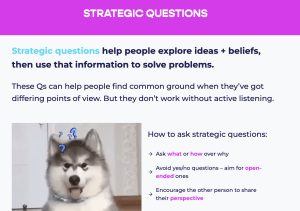
Strategic questions are a special kind of question that are designed to help people explore their own ideas and beliefs and use that information to solve problems. These questions are rooted in genuine curiosity. Asking strategic questions can help people discover common ground when dealing with an issue or differing points of view in a relationship.
Strategic listening can be challenging for both the listener as well as the person being questioned. This is because it requires active listening and empathizing with perspectives we may not agree with. It invites us to accept new information and be open to changing our minds.
Here are guidelines for asking strategic questions:
- Ask WHAT or HOW rather than WHY. It’s a subtle distinction, but asking “What gets in the way of you getting your homework done?” is more solution-oriented than “Why can’t you get your homework done?”
- Avoid questions with “yes” or “no” answers. There’s a time and place for yes/no questions, but they rarely inspire deep reflection. And often, YES or NO ends the conversation. Go for the most open-ended answer you can.
- Invite the other person to share their perspective. This provides an opportunity for the other person to express or change their opinion and encourages collaborative problem-solving.
Teacher note: For more information about strategic listening, check out this resource from Fran Peavy, who is credited with creating the strategic questioning approach in the 1980s + 1990s.
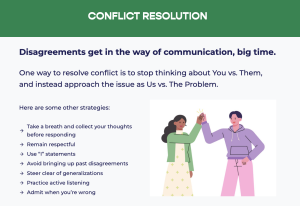
CONFLICT RESOLUTION
Conflict gets in the way of communication, big time. For starters, it's hard to keep your cool in the middle of a disagreement. But remaining respectful even when frustrated or angry helps protect and strengthen relationships.
Strategies to get there:
- Remember it’s not you vs. them, it's us vs. the problem.
- Take a moment to breathe and collect thoughts before responding in a difficult situation. This can help you respond calmly and constructively.
- Remain respectful through disagreements.
- Use “I” statements to stay focused on impact and to avoid making it seem like you know everything that’s going on with the other person. “You always take my stuff, you clearly don’t care” can make someone feel defensive, while “I feel frustrated when you borrow my stuff and don’t give it back” is less likely to (though it still might…)
- Avoid bringing up past conflicts when dealing with current ones. During an argument, try to remain focused on finding a solution to the present topic.
- Steer clear of generalizations like “You never let me…” or “you always do this.”
- Practice active listening during conflict and demonstrate you understand the other person’s perspective, even if you don’t necessarily agree with it. You might say, “I see where you’re coming from, but I feel differently because…”
- Admit when you’re wrong. Personal responsibility is a strength, not a weakness. Admitting when you’re wrong and taking accountability for hurting someone, even if it was unintentional, shows maturity and helps repair and strengthen relationships.
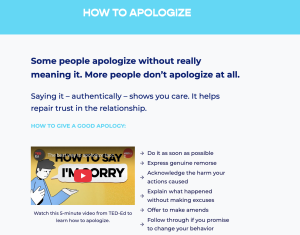
HOW TO APOLOGIZE
Many people apologize without really meaning it. More people don’t even apologize in the first place.
Apologizing —regardless of whether the affront was intentional or not—is an important element of effective communication. It demonstrates care about the other person and the relationship. Accountability is restorative, not punitive.
Giving a genuine apology requires emotional intelligence, humility, and vulnerability. It’s not always easy to own up to mistakes, but it goes a long way towards repairing trust in a relationship.
Here’s are some tips for apologizing well:
- Apologize as soon as you realize you made a mistake. A quick apology will lessen the damage. Depending on how deep the hurt went, more than one “I’m sorry” may be needed.
- Express genuine remorse. This means saying words like “I’m sorry” or “I was wrong.” Remember, the other person is not obligated to receive your apology. Also, the most genuine apologies are followed by a change in behavior.
- Acknowledge harm. Show that you understand you hurt somebody by naming the action you are apologizing for and recognizing that it was not acceptable. The more specific, the more authentic it feels.
- Explain what happened without making excuses. When we realize we made a mistake, often the first impulse is to get defensive and explain why it wasn’t actually our fault. But this approach can feel dismissive to the person you hurt. You can explain what happened while still taking accountability for your actions.
- Offer to make amends. As part of an apology, figure out how to repair the harm or shift behavior in the future so it doesn’t happen again. This step is important for rebuilding trust in the relationship.
Watch this 5 minute TED-Ed video on how to give a sincere apology.
Teacher note: Over-apologizing is a thing! Some people are too good at it – they take responsibility for things that aren’t their fault. This may come up in conversation, and is well worth getting into conversation about if time permits. For more strategies to give an effective apology, read this article from Leaving Evidence by Mia Mingus.
Activity: Open the PDF linked to the right for directions on how to lead an activity to designed to help students practice giving sincere apologies - Practicing Apologizing
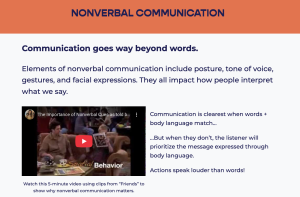
NONVERBAL COMMUNICATION
Communication goes way beyond words. Nonverbal elements of communication like posture, tone of voice, gestures, and facial expressions have a tremendous effect on how people interpret what we say because they can show our true feelings and attitudes. For example, crossed arms might signal defensiveness, while a yawn might indicate boredom.
Research suggests that when there are inconsistencies between attitudes communicated verbally and through body language, the listener prioritizes the message conveyed through body language. The good news is that this means offering a friendly smile, standing up straight, and making eye contact can go a long way towards making a good impression.
Pay attention to how people express themselves through body language. If someone says, “I’m fine” but rolls their eyes in annoyance, it might be worth checking in.
Nonverbal communication is clearest when it complements what is said verbally, so it helps to be aware that you are communicating nonverbally, too.
Watch this funny video from Kimberly Klawans that uses clips from the TV show Friends to demonstrate why nonverbal communication is important.
If you have an extra 15 minutes, watch this video from WIRED to hear from a former FBI agent about reading body language.
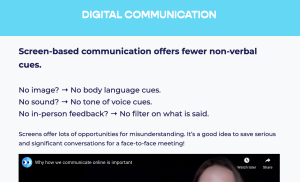
DIGITAL COMMUNICATION
When communication happens over a screen, there are fewer context clues. If there’s no image, then there’s no body language to read. When there’s no audio, there are tonal voice cues. And when there’s no one right there giving verbal or non-verbal feedback, people often do or say things they wouldn’t otherwise. Their filter comes off. All of this can increase the odds that words will be misinterpreted.
So save serious or significant conversations – like breaking up with someone or offering an apology – for a face-to-face conversation whenever possible.
Watch this 1 minute video from spunout to learn why how we communicate online matters.
COMMUNICATING PROFESSIONALLY ONLINE
In today’s world, a lot of important communication happens online. Students need practice with professional communication, whether it’s emailing a teacher to ask a question or applying for a job online.
These rules might not apply when texting a friend, but ask these questions before pressing send on a professional message of any sort:
- What time is it? Send professional messages during normal business hours (9am-5pm, Monday-Friday). Whenever possible, avoid sending professional messages on the weekends or late at night.
- How far in advance are you? Give the recipient ample time to respond to the inquiry. For example, if a student is letting a teacher know that they will be absent, emailing them a day or two before is usually fine. But if they are requesting a letter of recommendation, they should really reach out at least one month before your application deadline.
- Is the message concise? People are busy! They will usually prefer a shorter, direct message than a rambling one.
- Is the language clear + appropriate? This means avoiding slang, abbreviations, and excessive emojis. Pro tip: Check to make sure that the email address that you are sending from is appropriate, too!
- What’s the tone? Be mindful of how you come across in your writing online. The goal is to be polite and friendly. Avoid using sarcasm because it can be difficult to understand online, and it isn’t considered professional.
Activity: Open the PDF linked to the right for instructions on an activity for students to apply this knowledge and practice writing a professional email - How to Write a Professional Email
SUMMARY
Effective communication skills include active listening, strategic questioning, and apologizing. They make people feel heard, understood, and cared for. And – big bonus – they help prevent misunderstandings and conflict. In every medium, whether spoken, written, or cued through body language, effective communication skills are key.
LET'S TALK ABOUT IT
When is it most difficult for you to communicate effectively with others? What strategies will you now use to make it easier?