
7th Grade: BRAIN DEVELOPMENT + DECISION MAKING_sandbox
BRAIN DEVELOPMENT + DECISION MAKING 101 — TEACHER NOTES
HOW TO USE THESE TEACHER NOTES
Description of this Class for Parents and Caregivers
Description of this Class for Parents + Caregivers — Español
Activity: The Brain is Under Construction
INTRO FOR EDUCATORS:
By the time a student hits middle school, their brain is halfway through its maturation… a process that doesn’t finish until they’re close to 30. It is the imbalance in this maturation––the fact that some parts of the brain send and receive signals much faster than others––that sits at the heart of middle school (and high school!) decision making. This lesson is all about these normal imbalances inside the maturing teen brain that make it harder (but not impossible) for adolescents to make consistently good decisions.
Brain maturation starts at birth and progresses for the next 3 decades, and as the brain matures it shifts how ideas are processed, emotions are expressed, thoughts are managed, and ultimately how decisions are made. As “immature” kids become “mature” adults, 2 things are happening inside their brains:
- Pruning: The brain itself is a mass of about 100 billion nerve fibers called neurons––when the neurons aren’t used, they die away.
- Myelination: The slow wrapping of the remaining neurons in a blanket of fat cells called myelin. A neuron covered with myelin sends signals faster––much faster! about 3000x faster––than an unmyelinated one.
Myelination happens in a very specific order and is considered complete only after the prefrontal cortex (the consequential decision-making part of the brain) is fully coated––this is the part that takes until most people are nearly 30. Some parts of the brain are fully mature by middle + high school though—namely the limbic system, the brain’s hub for emotion, risk taking, and reward-seeking. Because the limbic system is mature, it can send and receive brain signals faster than the prefrontal cortex, explaining why tweens and teens are generally more likely than people of other ages to make impulsive, emotionally-driven choices.
While brain maturation (namely, myelination) and puberty happen independent of one another, puberty’s sex hormone shifts do impact how the brain responds. Testosterone, estrogen, and progesterone seep into the fluid that surrounds and cushions the brain––their presence changes how neurons communicate and, in turn, how adolescents act and feel. More than the sex hormones themselves, it’s their rising and dropping levels that impact tween and teen brains the most. So yes, the presence of testosterone (or estrogen) turns out to be impactful on decision-making, but rapidly rising and dropping testosterone (or estrogen) is even more impactful.
Explaining this science to students helps them to understand why they sometimes struggle to make the best decisions. Kids often feel embarrassed and ashamed when they do something thoughtless or downright foolish. It helps to know that their choices can be connected to uneven myelination. When we offer them strategies to overcome limbic system dominance, they really can make better choices and feel more in control.
If you’re looking for resources to learn more, there’s this one from the American Psychological Association about what neuroscience tells us about the teenage brain; this one from PBS about how adolescent brains are works in progress; and this one from CHOC offering a parent’s guide to understanding the teenage brain.
For those who prefer to listen, check out these episodes of the This Is So Awkward podcast: Dr. Molly Colvin on the “Consistently Inconsistent” Adolescent Brain or ADHD, Hormones, and the Adolescent Brain.
ICE BREAKER
Think about a regrettable decision you've made. Was it silly? Dangerous? Irresponsible? Why do you think you did it?
LEARNING OBJECTIVES
- Understand brain development and myelination.
- Learn about the limbic system dominance during puberty.
- Develop strategies for good decision making.
PRUNING
Brains mature in two ways: through pruning and myelination. These processes change how signals are sent through the brain.
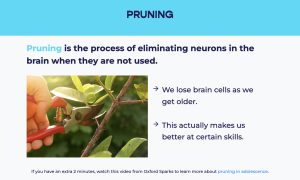
As we get older, we actually *lose* neurons! Pruning is the process of eliminating neurons in the brain when they are not used. It's like pruning a tree.
The nerves we use are saved, but the ones we don’t are lost. This is what makes us better at certain skills (like speaking a language or playing an instrument). It’s also what makes it harder for adults (with fewer brain cells!) to pick up a new skill or hobby.
If you have an extra 2 minutes, watch this video from Oxford Sparks to learn more about pruning in adolescence.
Teacher note: The language of brain science can get confusing. Quick definition of terms here, in case you’re asked: A “neuron” is a single nerve cell. A “nerve” is technically a bundle of axons (long arms) from several different neurons, but this term is often used synonymously with neuron.
MYELINATION
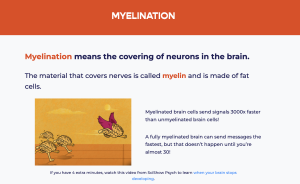
Myelination means the covering of neurons in the brain. When we’re born, the cells in the brain start out as naked neurons, but over time, many of them are covered with an insulating layer of fat cells, called myelin.
The brain sends electrical signals. Those signals move much faster when the nerve is insulated (myelinated).
- Myelinated neurons are fully insulated.
- The layer of fat cells allow for electrical signals to travel faster by covering the nerve underneath.
- They’re like wires covered with plastic––think about a phone or computer charger cord.
- Naked wires send messages slowly, but covered ones send them fast and you don’t get shocked when touching them!
- Myelinated neurons send + receive information 3000x faster than unmyelinated ones.
When people talk about “mature” brains, most of the time they are referring to brains that are fully myelinated. The limbic system (the emotional center of the brain) is myelinated by middle school, but the prefrontal cortex (the part of the brain that weighs consequences) won’t be myelinated until close to age 30!
- This difference in myelination timing is the reason why the limbic system dominates decision making in the tween and teen brain.
- A fully myelinated brain can send messages throughout the brain equally fast.
If you have 4 extra minutes, watch this video from SciShow Psych to learn when your brain stops developing.
SIGNAL SPEED MATTERS
Think of unmyelinated neurons like dirt roads, and myelinated ones like paved highways. Cars can travel on both, they just go a lot faster on smooth paved highways compared to bumpy dirt roads. Like cars, nerve signals can travel through both myelinated and unmyelinated neurons––but they'll be sent much faster along myelinated pathways.
Nerves transmit electrical signals. These signals travel much faster and more efficiently when a neuron is myelinated.
- Myelinated neurons can send and receive messages 3,000 times faster than unmyelinated ones.
- These signals don't spread to neighboring neurons, so any part of the brain that has myelin around its nerves gets messages much faster than parts that don’t.
- This is the same reason that wires like the ones in your cellphone or computer charger are coated in plastic––so you don't get a shock when you touch them.
Here’s the 4 minute video in the slide: The Remodeling Brain with Dr. Dan Siegel.
If you have an extra 4 minutes, watch this video from the Decision Education Foundation to learn why it can be a good thing for teens to make risky decisions.
BEING PARTIALLY MATURE
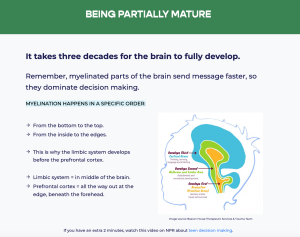
It takes three decades for the brain to fully develop. Myelin is laid down in a very specific order. Remember, the parts of the brain that are myelinated send signals more efficiently, so they dominate decision making. Myelination happens from the inside and bottom of the brain and works outwards and towards the top.
- Myelination starts at birth.
- It travels upwards and outwards.
- It starts at the bottom of the brain (near the neck) and works its way up.
- It starts in the innermost area (between the two hemispheres) and works its way out.
- By middle school, myelin has reached the halfway point through the brain.
- The full brain won’t be fully covered with myelin for another couple of decades!
THE DOMINANT LIMBIC SYSTEM
The order of myelination explains tween + teen decision making. The limbic system (in the middle of the brain) is myelinated before the prefrontal cortex (at the upper edge beneath the forehead). The limbic system will send + receive messages faster than the prefrontal cortex until the brain is fully mature (somewhere between ages 25-30).
The limbic system is the feel-good center of the brain.
- It is the site of motivation, memory, risk taking, emotions, reward seeking, and pleasure.
- It’s actually a collection of a bunch of different brain structures including the hippocampus and the amygdala.
- It can drive impulsive (usually not the wisest) decisions.
- It can also motivate positive behaviors.
- If you study hard for a test and you do well and that feels good, you will be motivated to study again – thank you, limbic system!
The limbic system is lit up by peers but not adults. This is why friends might encourage more risk-taking behavior: it’s because the limbic system responds to friends being around. This happens both in real life and online.
The prefrontal cortex is the last part of the brain to myelinate, so it sends and receives messages much more slowly than the limbic system. This lasts until a person is in their late 20s (a couple of decades from now!).
- The prefrontal cortex is in charge of consequential thinking, executive function, and planning.
- It’s the part of the brain that weighs the outcomes of two competing choices: If I do this, this will happen, but if I do that, that will happen… I should do that.
The prefrontal cortex is designed to balance the limbic system. But it can’t do that job very well when the limbic system is myelinated and the prefrontal cortex is not! If there’s a race between signals inside the brain, the signals going to and from the “feel good” limbic system will move a lot faster than the ones going to and from the “smarter” prefrontal cortex.
Here’s the video in the slide: Brain Development Explained.
If you have an extra 2 minutes, watch this video from Dovetail to learn more about decision making and the adolescent brain or this video on NPR about teen decision making.
ACTIVITY: Open the PDF for instructions on how to lead an interactive activity reviewing brain development concepts - The Brain is Under Construction
MAKING GOOD DECISIONS
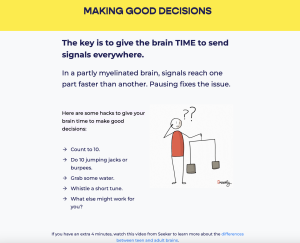
The key is to give the brain time to send signals everywhere. When the brain is fully myelinated, signals reach every corner quickly. But when the brain is only partly myelinated, signals reach one part faster than another.
The solution is to give signals the chance to get to the prefrontal cortex––this way the brain can use the input from the prefrontal cortex in its decision-making. We’re not talking a lot of time here––just a few seconds is often all it takes.
Here are some hacks to give the brain time to make good decisions:
- Count to 10
- Do 10 jumping jacks or burpees
- Text your parent
- Get a drink of water
- Go to the bathroom
- Whistle happy birthday
- What else might work?
If you have an extra 4 minutes, watch this video from Seeker to learn more about the differences between teen and adult brains.
Teacher Note: Kids often feel really crummy when they make a bad decision. It might seem like everyone is disappointed in them––parents, teachers, friends. But some of the poor decision-making of the tween and teen years has to do with uneven myelination. Signals are getting to the limbic system before they get to the prefrontal cortex. This drives choices to do things that feel good over things that have better long term consequences.
SUMMARY
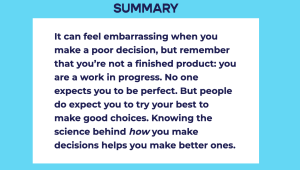
It can feel really embarrassing when you make a bad decision, but it’s important to remember that you’re not a finished product – you are a work in progress. No one expects you to be perfect, but they do expect you to try your best to make good choices. Knowing the science behind how you make decisions helps you make better ones.
LET'S TALK ABOUT IT
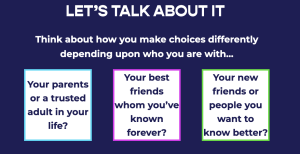
Think about how you make choices differently depending on who you are with...
- Your parents or a trusted adult in your life?
- Your best friends whom you've known forever?
- Your new friends or people you want to know better?
SCENARIO
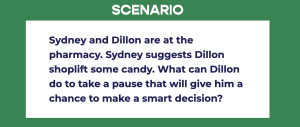
Sydney and Dillon are at the pharmacy. Sydney suggests Dillon shoplift some candy. What can Dillon do to take a pause that will give him a chance to make a smart decision?