
2nd Grade: CONFLICT RESOLUTION SKILLS_sandbox
CONFLICT RESOLUTION SKILLS – TEACHER NOTES
HOW TO USE THESE TEACHER NOTES
Description of this Class for Parents + Caregivers
Description of this Class for Parents + Caregivers — Español
INTRO FOR EDUCATORS
Through grade school, friendships often become more complex. There are so many reasons for this:
- Physically, kids develop at different ages and rates. So some kids look and act older than others, get involved in different activities, or have different physical abilities which can impact friendship dynamics.
- Emotionally, kids begin to experience feelings of exclusion, jealousy, or misunderstanding. Often at this age, they don’t have the language or tools to work through these feelings.
- Intellectually, kids’ curiosities and strengths begin to diverge. Learning differences also tend to appear as students move from learning to read to reading to learn.
- Interests evolve, as kids begin to identify the sports + activities they enjoy. Friendships built off frequent playdates shift as kids engage in different activities both during and after school.
- Cliques and social groupings can emerge, leading to exclusion or unkindness. (This is covered in detail in the lesson on WHAT IS FAIRNESS?).
There’s lots written about the importance of establishing at least one close friendship in grade school (examples of articles include this one from Early Childhood Research Quarterly and this one from Public School Review.) There’s less written about shifting friendships until middle school… and then the library seems endless (here are just 3 examples: this one about children’s conceptions of friendship, this one about the power of friendship, and this one about the developmental stages of social emotional development)!
Still, we’re not telling you anything you don’t know (because you see it play out every single day): social dynamics are in flux at this age, and kids need to learn basic conflict resolution skills to help them navigate these shifts. A close friend may eventually become an acquaintance; a non-friend may turn into a bestie. These moving parts impact everyone in a class (or any social group), and conflict is inherent.
This lesson normalizes conflict as a part of friendship and introduces skills for recognizing, talking about, and repairing hurt feelings. It also teaches students when to ask for help if something feels confusing or unfair.
Want more from experts? This article from the American Psychological Association offers teaching tools for navigating friendships and this one from the Kids Mental Health Foundation has tips on coaching kids through friendship conflict. You can also listen to one of these episodes of This Is So Awkward podcast to learn even more: How to be a good friend or How to navigate changing friendships or NOW WHAT?!: Apologies.
Here are the learning objectives for this lesson:
- Identify what makes a genuine friendship.
- Learn how to talk about hurt feelings and work through small conflicts.
- Practice kind, honest ways to repair when you’ve made a mistake.
- Understand that all friendships have ups and downs.
Here are the activities that go with this lesson–– you can incorporate them into the teaching (they’re also linked in the corresponding section below) OR use them at the end to reinforce the concepts.
ICE BREAKER
What’s a quality you value in a good friend?
Teacher note: Allow students to share their ideas. Use responses to highlight that friendship is about how someone makes us feel, not just who we sit with or play with.
GENUINE FRIENDSHIP
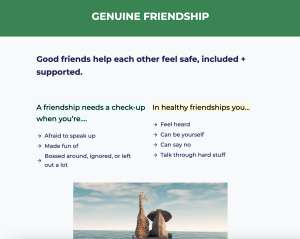
Good friends help each other feel safe, included, and supported. Signs of a healthy friendship include:
- You can be yourself
- You feel heard
- You feel safe saying no
- You can talk through hard stuff and still care about each other
Healthy friendships don’t always feel perfect. Friends can get upset with each other, but they get past it when they respect each other and communicate about what went wrong.
These are signs that a friendship isn’t working:
- You feel bossed around, ignored, or left out a lot
- You’re afraid to speak up
- You’re being made fun of, especially about things that matter to you
Teacher note: This is a great time to have the class build out a longer list of signs of a healthy friendship. You might want to echo back to the icebreaker question (What’s a quality you value in a good friend?) and the answers students came up with to illustrate that they already have healthy friendships. Remind students that friendship is a two-way street. If friend dynamics are tricky within the class, steer clear of calling out specific examples by talking about patterns instead—things like leaving friends out, even by accident; forgetting to listen; or not noticing how someone else is feeling. These are learning moments, not labels.
ACTIVITY: FRIENDSHIP FEELINGS MATCH
The “Friendship Feelings Match” activity helps students think about the kinds of feelings that might result from actions. Open the PDF linked to the right for directions and materials to lead this activity - Friendship Feelings Match
WHAT TO DO WHEN YOU’VE HURT A FRIEND
Even best friends make mistakes about how they treat one another. It’s important to remind students that mistakes don’t make them bad people—and when they’re repaired, they will learn + grow. This is covered in the MISTAKES + REPAIR lesson.
Here’s how to fix a mistake that has really upset a friend:
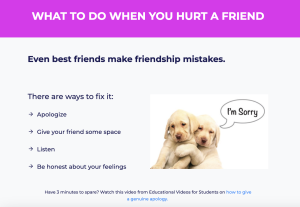
- Apologize. Say “I’m sorry” and really mean it. A genuine apology includes saying what happened, acknowledging how the other person might have felt (showing that you have thought about this), and saying what you’ll try to do differently in the future.
- Make space. Just because you have been thinking a lot about your apology doesn’t mean your friend has had time to do the same. Some kids need to take a break before they are ready to hear what you have to say.
- Listen. Sometimes when a friend says “I’m sorry,” we answer with “It’s fine”—even if we’re still feeling a little hurt or upset. It’s important to allow your friend to truly say what they are feeling. They may still be upset, and it’s unfair to expect them to say, “It’s fine” or “Don’t worry about it.”
Teacher note: Students process mistakes in lots of different ways. Sometimes, even when a person knows they have messed up, apologizing right away can feel too hard. It’s okay to validate their need to calm down first––the key is for them to tell the other person they need a minute. Conflict resolution (at any age!) is rarely as simple as: I did something wrong, I totally own it, and I am instantly ready to say sorry.
CLASS EXERCISE: Practice genuine apologies. You can use this example to illustrate. You and your friend are playing a game, and they win. You get mad and throw the game pieces at the wall. Your friend is shocked.
- Apologize: say “I’m sorry.” You could say something like, “I’m sorry I threw the game pieces when I got mad. I won’t do that again.”
- Make space: give your friend some space. Ask, “Do you want to play a different game or do you want to take a break?”
- Listen: hear what your friend says and respect their feelings.
If you’d like a video to reinforce some of these concepts, spend 3 minutes watching this from Educational Videos for Students about How to Apologize to Someone You Hurt.
WHAT TO DO WHEN A FRIEND HAS HURT YOU
Friendships are 2-way streets––we’ve all been on the receiving end of being hurt.
- Sometimes it’s easy to say how you feel.
- Other times it’s hard to find the words.
- No matter what, speaking up takes courage.
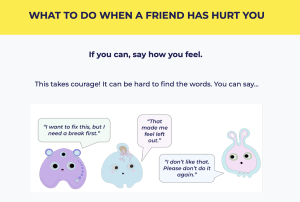
If a friend hurts you, it’s OK to say things like:
- That made me feel left out.
- I don’t like that. Please don’t do that again.
- I want to fix this, but I need a break first.
If a friend wants to apologize, give them a chance.
- This might not happen right away, especially if one person in the friendship is taking a cool-down break.
- And with an apology, no one is expected to automatically say “It’s fine”––that can ignore genuine feelings.
If someone apologizes, and you’re still feeling a little sad, you can say things like:
- “Thank you for saying sorry. I’m still feeling a little upset, but I’m glad you told me.”
- “Thank you, but I need a little time.”
- “I appreciate the apology. Let’s work on fixing it together.”
CLASS EXERCISE: Put students in pairs or small groups to act out these short scenes of low-stakes friendship conflicts. Students can take turns practicing both roles—as the person who got hurt and the person doing the repair.
Read these prompts out loud one at a time:
- Your friend tells you that your favorite show is “for babies.”
- You tell your friend something personal and later hear them talking about it with someone else.
- Your friend borrows your markers without asking and loses one of them.
- You and your friend are playing a game, but they keep changing the rules so that they can win.
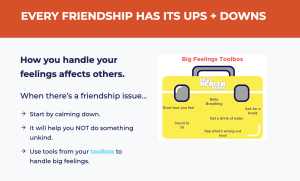
EVERY FRIENDSHIP HAS ITS UPS + DOWNSEveryone has big feelings––like anger, jealousy, or feeling left out––from time to time in their friendships. Here are some ways to handle those feelings:
- When something goes wrong in a friendship, calm down before trying to fix it.
- People who aren’t calm are more likely to say or do something that will be unkind or disrespectful.
- This has happened to everyone—maybe it even happened earlier today!
- No human is their best self when they’re mad.
Brainstorm ideas for handling big feelings: Apply the skills learned in the LISTEN TO FEELINGS lesson (listed here, too).
- Belly breathing*
- Counting slowly to 10
- Getting a drink of water
- Asking for a break
- Drawing how you feel
- Saying what’s wrong out loud (“I’m mad because I lost!”)
*Teacher note: Belly breathing is a way to slow down and feel calm. Breathe in deeply through your nose, and let your belly fill up like a balloon. Then slowly breathe out through your mouth and feel your belly go down. Sometimes it helps to put a hand on your belly to feel it expand and contract. This type of breathing delivers more oxygen to the brain, slows down the heart rate, and relaxes the body, especially during moments of stress. Here are two videos that can help lead belly breathing: One-minute video for a visual way to practice belly breathing OR This instructional video that can lead a belly breathing exercise.
ACTIVITY: MY FRIENDSHIP TOOLBOX
Hand out the My Friendship Toolbox and ask students to cut out the tools and glue their top 3-5 tools on the toolkit. Ask students to share with a partner why they picked the tools they did. Open the PDF linked to the right for the materials to lead this activity - My Friendship Toolbox
SUMMARY
Friendships have ups and downs, but practicing kindness, honesty, and respect makes them stronger.
LET’S TALK ABOUT IT
Ask:
- What’s something a friend has done that made you feel included?
- What can you say if a friend hurts you?
- How do you fix things when you make a mistake with a friend?