Kindergarten: PERSONAL SPACE + PRIVACY_sandbox
PERSONAL SPACE + PRIVACY – TEACHER NOTES
HOW TO USE THESE TEACHER NOTES
Description of this Class for Parents + Caregivers
Description of this Class for Parents + Caregivers — Español
INTRO FOR EDUCATORS
This lesson helps students build a foundational understanding of personal space and privacy—key concepts in developing bodily autonomy, respectful boundaries, and self-advocacy. For many kids this age, this may be the first time they hear terms like “private parts” or “personal space” in an educational setting, so it’s important to model a calm, clear tone and avoid euphemisms or shame-based messaging.
The focus is on these core messages:
- Your body belongs to you.
- Everyone deserves space and privacy.
- We ask before touching others.
- You can say no if someone touches you in a way you don’t want or like.
Children’s brains are wired to mimic and seek connection through touch, but their impulse control is still developing. By teaching body boundaries early, we help activate prefrontal cortex functions like self-monitoring and empathy.
Teaching kids about consent is a fundamental building block for healthy relationships starting at the earliest ages and long before the concept of sex enters the equation. Consent is about asking for permission and requiring others to ask permission of us. It communicates to kids that they have power over what happens to them and agency that their bodies belong to them. It also emphasizes that all people deserve to be treated with respect and dignity. All of our consent lessons were created with guidance and input from health educator, Shafia Zaloom. For educators looking for an in-depth exploration of consent, we recommend Shafia’s book Getting Real About Sex Ed.
If you are looking for more content related to body signals, check out these episodes from the This Is So Awkward podcast: Beginner Conversations about Consent and What it Means to be Body Literate.
Here are the learning objectives for this lesson:
- Understand what personal space is and why it matters.
- Learn about privacy and how it keeps us safe.
- Begin to identify body parts that are private.
- Practice asking for and giving permission before touching others.
- Know who to talk to if someone makes you feel uncomfortable.
Here are the activities that go with this lesson–– you can incorporate them into the teaching (they’re also linked in the corresponding section below) OR use them at the end to reinforce the concepts.
- Personal Space + Privacy Class Activities (How to Say No; My Bubble; Just Me or Everyone; Respectful or Not)
ICE BREAKER
Do you like hugs, high fives, or fist bumps best?
Teacher note: Let students respond and notice how answers differ and make the point that we all like different kinds of touch. It’s up to each one of us to decide what we like best.
EVERYONE HAS AN INVISIBLE BUBBLE
We all have something called personal space.
- It’s an invisible bubble around our bodies that helps us feel safe and comfortable.
- Some people like big bubbles. Some people like smaller ones.
- If someone steps too close without asking, it can feel uncomfortable—even if they don’t mean to be unkind.
The part of the brain that helps us interpret nonverbal cues (like body language and facial expressions) is still developing at this age. By practicing space awareness and learning to “read the room,” students can strengthen both social-emotional and self-regulation skills.
Ask:
- What do you think your space bubble looks like?
- How can you tell if someone wants more space?
- What could you say if someone gets too close?
ACTIVITY: BUBBLE ZONES
Tape 2–3 large circles on the floor (“bubble zones”). Assign students to stand or move inside them. Others walk freely around the room. Other students outside the zones must walk around without stepping inside someone else’s bubble zone. If they want to enter a bubble zone, they can practice pausing and asking: “Can I come in?” before entering someone’s circle.
ACTIVITY: MY BUBBLE
Print a “My Bubble” worksheet for each student in the class. Open this PDF for directions and materials to lead all of the Personal Space + Privacy activities - Personal Space + Privacy Class Activities
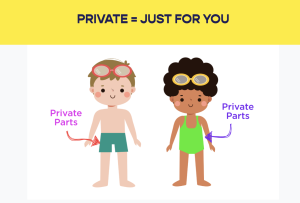
Teacher note: You have access to a toolkit with slides should you want them. The slide above shows private parts covered by bathing suits.
Teacher note: Some schools and some families opt to begin educating kids on the anatomical names for their private parts. This is considered best practice for educating kids of all ages because research shows that knowing the anatomically correct names and functions of body parts helps keep kids safe and healthy. When teaching this section, we recommend using terms like “penis” and “vulva” if you’re comfortable doing so in order to promote body knowledge. We understand that this may be the first time you’re using terms like this in the classroom and that it might feel uncomfortable. For more information on why using accurate language matters, check out this article from Nationwide Children’s or this one from the American Academy of Pediatrics. For more detailed information on the reproductive organs, check out the 5th grade lessons MALE ANATOMY 101 and FEMALE ANATOMY 101.
Some parts of our bodies are private, which means they are not for others to look at or touch. These parts of the body are the ones covered by a bathing suit.
Watch this 1-minute song from a teacher in Namibia about body boundaries from NBC San Diego. It is also linked in the slide.
We also have private times and private places.
- One example of a private time is going to the bathroom.
- One example of a private place is where you go to get dressed.
The key is for students to learn how to respect other people’s privacy by knocking, giving space, and keeping their eyes + hands to themselves.
Ask:
- What does the word private mean?
- Where do we need privacy?
- What would you do if someone tried to look or touch when you didn’t want them to?
Teacher note: Per the teacher note above, below is some language you can use if you opt to introduce the anatomical terms for private parts. Open the PDFs linked to the right for some diagrams of these body parts that you can reference; note that these diagrams are not meant to be shown to students in class - Female Anatomy Diagrams and Male Anatomy Diagrams.
External male parts:
- Penis: This organ hangs outside of the body below the pelvis—it’s made up of a long narrow shaft and a tip (called the “head” or the “glans”).
- Urethral opening: The urethra is the tube that carries urine (pee) and semen (a mix of sperm + bodily fluids) out of the body. The hole at the tip of the penis is the urethral opening.
- Testicles: These two egg-shaped balls hang below the pelvis, inside the scrotal sac. This is where sperm and testosterone are made.
- Scrotum: The sac that covers and holds both of the testicles outside of the body.
External female parts:
- Vulva: this includes all of the external female genitalia: the labia, clitoris, urethra, and vaginal opening.
- Urethral opening: where urine (pee) comes out.
- Vaginal opening: where a baby can come out.
- Vagina: this is a muscle shaped like a tube that’s mostly inside the body (except the vaginal opening which can be seen from the outside).
- Labia: the skin folds outside of the vaginal opening (also referred to as “lips”)
- Clitoris: a small, sensitive bump where the labia come together.
- Breasts:* When breasts start to grow, they slowly change size and shape; the nipple on top also changes color and texture.
*Teacher note about breasts: Regardless of gender, all humans have breast tissue. But without estrogen stimulation, breasts won’t develop. Half of all males have enough estrogen in their bodies to experience some breast growth during puberty; it’s usually limited to breast budding, and the buds generally flatten down again (medical term: involute) after a few months. When males have breast growth, it’s called gynecomastia. Sometimes it happens on one side, sometimes both. Any person nervous about breast growth should speak to a healthcare provider. There’s also lots of information about breast growth + development in the Hub.
ACTIVITY: JUST ME OR EVERYONE?
Print a “Just Me or Everyone” worksheet for each student in the class. Open the PDF linked to the right for directions and materials to lead all of the Personal Space + Privacy activities - Personal Space + Privacy Class Activities
ASK FIRST AND FOLLOW THE ANSWER
Some kids love hugs. Others prefer high fives. Some days we feel cuddly, and some days we need space. That’s why we always ask first before we touch someone else.
If someone says “No,” “Stop,” or looks uncomfortable, we stop, even if we didn’t mean to hurt their feelings. Practicing this helps develop empathy circuits and gives children scripts to handle peer interactions, especially when boundaries differ.
Ask:
- What can you say if you don’t want a hug?
- How do we know if someone else wants to play with us or not?
- What can you do if someone doesn’t stop when you say no?
ACTIVITY: HOW TO SAY NO
Brainstorm as a class some ways to say no when someone crosses a boundary. Open the PDF linked to the right for directions and materials to lead all of the Personal Space + Privacy activities - Personal Space + Privacy Class Activities.
ACTIVITY: RESPECTFUL OR NOT?
Print a “Respectful or Not?” worksheet for each student in the class. Open the PDF linked to the right for directions and materials to lead all of the Personal Space + Privacy activities - Personal Space + Privacy Class Activities
SUMMARY
Everyone deserves privacy and personal space. Your body belongs to you. You can say yes or no to touch, and it’s important to respect when someone else says no, too.
LET’S TALK ABOUT IT
Ask:
- What does personal space mean to you?
- How can you show someone you want space?
- Who can you talk to if something feels uncomfortable?