
8th Grade: HEALTHY RELATIONSHIPS + INTIMACY_sandbox
RELATIONSHIPS + INTIMACY - Teacher Notes
HOW TO USE THESE TEACHER NOTES
Description of this Class for Parents and Caregivers
Description of this Class for Parents + Caregivers — Español
Activity 1: Think of a Bear...
Activity 2: Love Language Baskets
INTRO FOR EDUCATORS
In generations past, there was no formal education about healthy relationships. Recently, though, we’ve seen a cultural shift acknowledging the importance of this kind of teaching. As a result, students are much more likely to have school-based opportunities to talk about how to form caring and intimate connections.
Mastering how to have sustained, healthy intimate relationships is a developmental task of adolescence. Kids must learn about the interpersonal skills that foster authentic human connection and all of the different ways to communicate with others because the delivery makes a difference. This teaching is a wonderful opportunity to illustrate the pathways to respectful platonic or romantic closeness; it also gives kids the chance to explore the hurdles that can get in the way.
While this lesson covers intimacy, it isn’t only about physical sexual acts. Intimacy as a concept includes so much more that has nothing at all to do with sex, principles like:
- Opening up emotionally
- Practicing reciprocity
- Being willing to be vulnerable
- Using effective communication
While our culture has improved when it comes to talking about relationships, it still evades healthy vulnerability, generally equating it with weakness. This lesson encourages a counter narrative. Vulnerability––which means taking physical and/or emotional risks without knowing what the outcome will be––can and should be framed as a strength because it’s central to authentic connection, forming the foundation for intimacy.
Ultimately, when it comes to relationships and intimacy, effective communication involves reciprocal sharing: it’s the questions we ask, how we get curious, how we listen, and how we respond all in an effort to get to know someone better. If you are looking to read more on the topic, this article from KQED about how to teach teens about love, consent, and emotional intelligence features That Health Class contributor, Shafia Zaloom; this one from NYTimes about how social interaction is critical for mental and physical health, and this video from TED about what makes a good life to learn more. There’s also lots of helpful information through Love Is Respect and One Love Foundation. If you have 20 minutes, watch this TED talk from Brene Brown on The Power of Vulnerability to contextualize this lesson.
And if you prefer audio deep dives, listen to the This Is So Awkward podcast episodes about healthy relationships in middle school: Middle School Romance and First Loves and Desires.
ICE BREAKER
Ever heard the phrase "Rome wasn't built in a day"? What does this phrase have to do with authentic relationships?
Teacher note: One great way to open up this class is to begin with a conversation about how deep and lasting connections take time, patience, and effort.
LEARNING OBJECTIVES
- Identify the keys to positive communication.
- Recognize the need for human connection.
- Understand the building blocks of intimacy.
POSITIVE COMMUNICATION
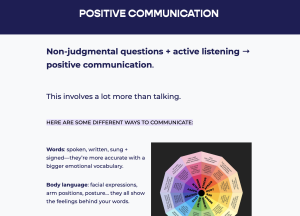
The keys to effective, positive communication are non-judgmental questions and active listening. These must be communicated clearly, which can take practice.
Communication often involves talking… but not always! Here are some of the big categories of communication:
Words: Language can be spoken, written, sung, and signed using ASL. Words are more accurate when we have a bigger emotional vocabulary.
- Specific words can accurately express how we feel.
- The more nuanced words we choose, the more detailed and effective the communication.
- This is why it helps to try to avoid words like “good” and “bad” when describing how we feel.
- Instead, try to think of something more specific to explain your emotional state.
- If you’re stuck, consider using a feelings wheel or chart.
Body language: This is how we physically show others how we feel. Especially when combined with language coming out of the mouth, body language helps others understand what we’re trying to say. But it “speaks” loudly even without words!
- Facial expressions –– smile, smirk, grimace, pursed lips, wide eyes, squinting...
- Head movements –– nodding, shaking, head dropped down, chin in the air…
- Arm positions –– crossed, relaxed by your side...
- Posture –– slouched vs. straight back, shoulders up by ears or relaxed and low…
- Direction –– are two people facing each other or away from one another or something in between?
Most of the time, the words, their tone, and the body language are all consistent.
- When someone is angry their words might be harsh, their voice might be loud or tense, and their face and body might convey anger with crossed arms or a turned back.
- When someone is feeling loving, their words are kind and their expression, body position, and demeanor tend to all suggest they feel comfortable and relaxed and happy to be in conversation.
- But sometimes the words suggest one set of emotions and the body language suggests another––this can be confusing because it sends mixed messages. When this happens, it can help to ask clarifying questions.
Reciprocity: This is the balance of energy and investment between two people––getting to know someone while letting them get to know you. It’s a measure of give-and-take.
- Reciprocity can be observed in dialogues and relationships.
- Do both people speak about the same amount?
- Are the feelings being conveyed similar?
- When interest is reciprocal, it’s mutual: both people are interested in getting to know one another better or invested in being there.
Have 2 extra minutes? Watch this video from MassDPH on respectful + clear communication or this one from HeartlandZA on active listening.
ACTIVITY: THINK OF A BEAR
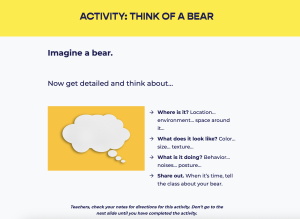
This activity is a helpful analogy/exercise for middle school students to understand the value in (1) asking clarifying questions and (2) active listening when participating in intimate relationships. Open this link for directions on how to lead this activity - Think of a Bear...
Teacher note: Don’t advance to the next slide until you have completed the activity; the next slide is a summary slide.
LOTS OF DIFFERENT BEARS!
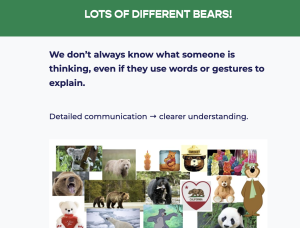
Students may have expected everyone to picture the same bear, but this activity demonstrates that there are infinite different bears we could imagine.
This means that we don’t always know what someone is thinking, even if they use words or gestures to explain. Detailed communication is more effective – it can help distinguish Yogi Bear from a grizzly!
NEED FOR CONNECTION
Humans are social animals. As a species, we have a desire to be close to other people. We need social connection and communication to survive.
- This quality of these connections contribute to our overall well-being.
- The psychological and physical health benefits of social contact actually increase our longevity.
- Having positive relationships with family, friends and community helps us recover from stress, anxiety and depression.
- It promotes healthy eating and physical activity and improves our sleep, wellbeing and quality of life.
- Connection can lead to emotional intimacy.
- Social connection can even help prevent serious illnesses like heart disease, stroke, dementia, anxiety and depression.
And of course, feeling connected to others cultivates joy in our lives. Positive communication doesn't mean there is never conflict, but it does mean that we have the skills to listen to and respect each other when conflict arises.
If you have 4 minutes, watch this video from TEDEd on How Friendship Affects Your Brain.
BUILDING BLOCKS OF INTIMACY
Intimate relationships are built on authentic connection. Initiating, establishing and deepening intimacy happens through shared experiences and positive communication––this is how people can get to know each other in genuine ways. Relationships progress only as quickly as trust is built.
The principles of intimacy rely on the same skills as positive communication. These include:
- Opening up emotionally at the beginning of authentic relationships
- Willingness to be vulnerable, which is a key to positive, genuine communication.
- Practicing reciprocity, the back-and-forth that allows for true intimacy.
- Using effective communication by choosing words specifically and carefully.
Learning to communicate well starts with:
- Being honest
- Practicing curiosity
- Paying attention
- Listening
Here’s an example to explain these principles of intimacy in action: Bedtime when you were a little kid.
- It was a shared experience with someone who cares for you and you care for them.
- It happened regularly, so you could count on it happening.
- It was an enjoyable, focused time that felt affirming because there was trust and safety.
- For some kids sleep is a vulnerable state of being, so the closeness was reassuring and encouraged sleep.
- This reassurance through vulnerability and closeness is an example of intimacy and how it contributes to our wellbeing.
If you have 3 extra minutes, watch this video from Oasis Mental Health Application to learn more about building healthy relationships or this one from AMAZE on characteristics of healthy relationships.
LOVE LANGUAGES AND INTIMACY
Love languages describe the ways people are most comfortable expressing care and closeness with others. What builds intimacy is different for different people. While knowing what you want or like is a good start, it’s important to be able to communicate with your partner/friend/family member in an ongoing way.
The 5 love languages young people hear about the most are
- Acts of service
- Spending quality time
- Words of affirmation
- Physical touch
- Receiving and giving gifts
Teacher note: It’s important to highlight and recognize that intimacy comes in all forms. It is not always sexual.
Here are videos that explain these different love languages:
- Quality Time - The 5 Love Languages®
- Words of Affirmation - The 5 Love Languages®
- Receiving Gifts - The 5 Love Languages®
- Physical Touch - The 5 Love Languages®
- Acts of Service - The 5 Love Languages®
Have 3 extra minutes? Watch this video from AMAZE on first kisses and showing affection.
ACTIVITY: Students make their own love language baskets using this activity link: Love Language Baskets
SUMMARY
Building healthy relationships with other people takes bravery, vulnerability, and openness to intimacy. It also takes authentic, clear communication + active listening. Intimacy is not just sexual or romantic––it can describe many kinds of close connections with different people.
LET'S TALK ABOUT IT
- What is the bravest part of building new connections with others?
- Has your understanding of intimacy changed after this lesson?
- What's a new way you might look to build connection with another person?