
BRAIN DEVELOPMENT + DECISION MAKING 201_sandbox
BRAIN DEVELOPMENT + DECISION MAKING 201 — TEACHER NOTES
HOW TO USE THESE TEACHER NOTES
Description of this Class for Parents + Caregivers
Description of this Class for Parents + Caregivers — Español
Activity 1: Evaluating OTC Neurotransmitters
Activity 2: How to Hack Your Limbic System
Teacher notes are designed to supplement the slide deck for lessons throughout That Health Class. The goal of these supplemental notes is twofold:
- To offer basic background information on the topic for educators
- To offer a deeper dive into biology, physiology, and data for educators craving more information
Here’s how the teacher notes are organized:
At the start of each set of notes is a general INTRO FOR EDUCATORS – this information does not have a corresponding slide, but instead sets the stage for why this class is relevant and, in some cases, how the information has changed over time. It also includes an episode from the This Is So Awkward podcast that includes even more information on the topic.
Then follows a description of every slide in the deck. You will see thumbnail images of each slide, followed by detailed definitions and explanations of the text and/or videos included. Some sections contain links to PDFs containing examples and ideas for in-class exercises. These corresponding PDFs are also linked at the top of this document, just below the class description.
The LET’S TALK ABOUT IT section concluding each slide deck is meant to start conversations. It can be a jumping off point for wrapping up class discussions or can serve as an exit ticket if needed.
For more information on any given lesson across the entire That Health Class curriculum, we encourage you to login to the Less Awkward Hub or search the Resource We Love list.
INTRO FOR EDUCATORS:
This lesson is all about the normal imbalances inside the maturing teen brain that make it harder – but not impossible – for adolescents to make consistently good decisions.
Brain maturation starts at birth and progresses through puberty all the way up until a person is in their late 20s (some studies suggest nearly 30). The brain itself is a mass of about 100 billion of nerve fibers called neurons; it also contains 3 glands, which are organs that produce hormones. Two are essential to puberty – the hypothalamus and the pituitary gland – and one is all about sleep (the pineal gland, which secretes the hormone melatonin). Ultimately, it’s the hypothalamus and the pituitary glands inside the brain that act like orchestral coordinators of sex hormone cycling: they are responsible for the onset of sexual maturation and they remain intimately involved in reproductive health including the menstrual cycle.
When we talk about brain maturation, it’s not about the body’s shifts toward reproductive capability… Rather, it’s all about how ideas are processed, emotions are expressed, thoughts are managed, and ultimately how decisions are made. It’s about how “immature” kids become “mature” adults. This is driven by 2 phenomena:
- Pruning: when the neurons that aren’t used die away
- Myelination: The slow wrapping of the remaining neurons in a blanket of fat cells called myelin. A neuron covered with myelin sends signals faster – much faster! about 3000x faster – than an unmyelinated one.
Myelination happens in a specific order in the brain. It is considered done once the prefrontal cortex (the consequential decision-making part of the brain) is mature, which takes until they’re nearly 30. Some parts of the brain are fully mature by high school though—namely the limbic system, the brain’s hub for emotion, risk taking, and reward-seeking. Because the limbic system is mature, it can send and receive brain signals faster than the prefrontal cortex, explaining why teens are generally more likely than people of other ages to make impulsive, emotionally-driven choices.
While brain maturation (namely, myelination) and puberty happen independent of one another, puberty’s sex hormone shifts do impact how the brain responds. Testosterone, estrogen, and progesterone seep into the fluid that surrounds and cushions the brain – their presence changes how neurons communicate and, in turn, how adolescents act and feel. More than the sex hormones themselves, it’s their rising and dropping levels that impact tween and teen brains the most. So yes, the presence of testosterone (or estrogen) turns out to be impactful on decision-making, but rapidly rising and dropping testosterone (or estrogen) is even more impactful.
Explaining this science to students helps them to understand why they sometimes struggle to make the best decisions. Kids often feel embarrassed and ashamed when they do something thoughtless or downright foolish. It helps to know that their choices can be connected to uneven myelination. When we offer them strategies to overcome limbic system dominance, they really can make better choices and feel more in control.
For even more information on Brain Development + Decision Making, listen to this episode of the This Is So Awkward podcast: Dr. Molly Colvin on the “Consistently Inconsistent” Adolescent Brain
ICE BREAKER
Think about a decision that you’re really proud of… Now think about one that you deeply regret?
Were there any differences in how you made your choices in each scenario?
LEARNING OBJECTIVES:
- Learn about neurons + how they work in the brain.
- Understand how the brain matures through myelination + pruning.
- Recognize the impact of limbic system dominance on decision making.
- Practice strategies for good decision making.
NEURONS
Brains mature in two ways: through myelination and pruning. Both of these processes change how signals move between neurons. But how does the brain send these signals in the first place?
A neuron is a nerve cell that sends messages to other nerve cells.
- Each neuron has a central cell body, called a soma, that houses its nucleus – the nucleus stores the DNA and functions as the cell’s command center .
- Branching out from the cell body is one axon, a long spindly arm designed to send signals away from the cell body.
- Dendrites also branch out from the cell body. They are shorter arms that receive signals from neighboring neurons and bring those messages to the cell body. A neuron can have anywhere from one to several hundred dendritic trees, allowing for thousands of connections.
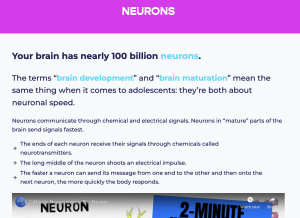
The terms “brain development” and “brain maturation” mean the same thing when it comes to adolescents: they’re both about neuronal speed.
Neurons communicate through chemical and electrical signals. Neurons in “mature” parts of the brain send signals fastest.
Watch this two minute video from Neuroscientifically Challenged to learn more about the structure and function of the neuron (also embedded in the slide).
HOW NEURONS COMMUNICATE
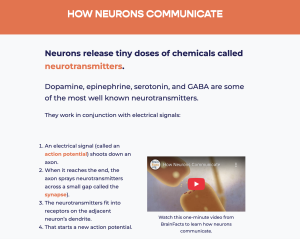
Neurons communicate with each other by releasing tiny doses of chemical messengers called neurotransmitters. These molecules that carry signals between neurons in the nervous system. Dopamine, epinephrine, serotonin, and GABA are a few of the most well-known neurotransmitters. The Cleveland Clinic has a nice explainer of how different neurotransmitters work.
- An electrical signal called an action potential shoots down an axon.
- When it reaches the end, the axon sprays neurotransmitters across a small gap called a synapse.
- The neurotransmitters fit into receptors on the adjacent neuron’s dendrite.
- That starts a new action potential.
Some neurotransmitters are EXCITATORY: they increase the likelihood of neuron firing. They’re like neurological green lights. Others are INHIBITORY: they reduce the likelihood of neuron firing. They’re like neurological red lights.
Why have both chemical and electrical strategies to send messages? Because an electrical impulse is essentially analog: it either happens or it doesn’t. Chemical signaling, on the other hand, can vary depending on the type, dose, and duration of the neurochemical release, making it more nuanced. Relying on one mode of communication within a single neuron and a different mode between neurons balances speed and message, sort of like sending the same letter both by snail mail and text.
Activity: Open the PDF linked to the right for an activity evaluating neurotransmitter supplements available OTC - Evaluating OTC Neurotransmitters
MYELINATION
The chemical exchange between the tips of two neurons requires a fixed amount of time for traveling. But electric signals can be sped along when the environment becomes more conducive—literally!
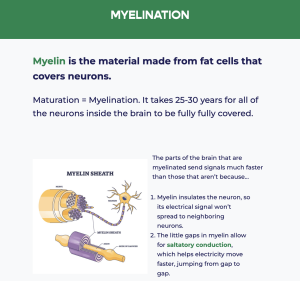
At birth, babies have more than 100 billion neurons packed into their brains. These cells start out naked, but over time, the arms of these nerves are covered with a layer of fat cells called myelin. The name for the process of insulating neurons in the brain is called myelination:
- When the neuron is insulated, signals won’t spread to neighboring neurons making it more efficient.
- This is the same reason wires like your cellphone charger are coated in plastic— so you don't get a shock when you touch them!
- Myelin also gets laid down with small gaps in between – this allows electricity to jump from gap to gap, a phenomenon called saltatory conduction.
- That’s why any part of the brain that has myelin around its nerves sends + receives messages much faster than parts that don’t.
When people talk about “mature” brains, most of the time they are referring to brains that are fully myelinated. The brain begins the process of myelination before birth, but it takes nearly three decades for the brain to fully mature!
SIGNAL SPEED MATTERS
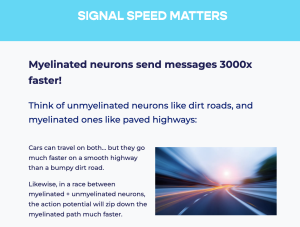
Remember that neurons transmit electrical signals down their long arms. These signals travel much faster when the neuron is myelinated. In fact, myelinated neurons can send and receive messages 3,000x faster than unmyelinated ones!
Think of unmyelinated neurons like dirt roads, and myelinated ones like paved highways. Cars can travel a lot faster on a smooth paved highway than on a bumpy dirt road. Like cars can travel on both kinds of roads, nerve signals can travel through both myelinated and unmyelinated neurons---but they'll be sent much faster on myelinated pathways.So, if two signals are sent to different parts of the brain at the same time—one signal slowly cruising along on an unmyelinated neuron and another zipping down a myelinated one—the one traveling on the myelinated path will win out because the brain receives and acts on that impulse faster.
The takeaway? The parts of the brain that are myelinated send signals more efficiently, so they dominate decision making.
ORDER OF MYELINATION
Myelination happens in a very specific order. It starts before birth at the bottom of the brain (near the neck, where the brainstem sits) and in the innermost area (between the two hemispheres). Over the next three decades, it works its way outwards and upwards.
By middle school, the brain is about halfway through its myelination. The order of myelination is why the limbic system (in the middle of the brain) develops before the prefrontal cortex (at the upper edge beneath the forehead)
Watch this 5 minute video from SciShow Psych to learn when the brain stops developing (spoiler alert: it keeps changing!)
For an overview of the major structures in the brains and their functions, watch this 5 minute video from the National Institute on Drug Abuse.
PRUNING
There are 2 ways the brain matures: myelination and pruning. Here’s the skinny on why we intentionally lose brain cells as we age.
This process is called synaptic pruning, and it is the biological version of “use it or lose it.” Pruning in the brain is just like pruning a tree – branches that are overgrown and underutilized get cut off. Same, same with neurons. In synaptic pruning, unused connections between neurons are eliminated.
The nerves we use are saved, but the ones we don’t use are lost. This explains why kids can try new things and pick them up with ease: they have many more potential neuronal connections that haven’t been destroyed yet! But it also explains why skills improve as those same kids become tweens and then teens and then adults: they have fewer and fewer neurons, but the ones they do have are well wired. You can teach an old dog new tricks…but the more pruning there has been, the harder it becomes.
Practice makes pathways! The more frequently a particular neuronal path is used, the more efficiently a signal gets transmitted. It’s like footpaths in the snow: the most walked-on paths become the flattest and easiest to follow. So practice really does make perfect or at least better!
Here’s the video in the slide: The Remodeling Brain with Dr. Dan Siegel (also embedded in the slide).
If you have an extra 4 minutes, watch this video from SciShow on neural plasticity.
Teacher note: Research published in the Proceedings of the National Academy of Sciences and covered in this summary article in HealthDay suggest isolation during the COVID-19 pandemic sped up brain maturation in girls. The study showed that teen brains pruned themselves faster than expected during the pandemic — with girls’ brains pruning 4.2 years ahead of schedule and boys’ brains 1.4 years ahead. This acceleration can be seen in response to stress, and is associated with mental health issues like depression and anxiety. We can’t jump to conclusions that this is a bad thing… all we can say is that it’s a thing.
THE DOMINANT LIMBIC SYSTEM
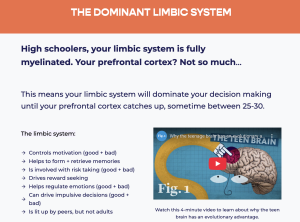
This fact has been repeated several times throughout this lesson, quite purposefully: it takes three decades for the brain to fully myelinate, and because the parts of the brain that are myelinated send signals more efficiently, they dominate decision making.
The teenagers in the classroom have fully myelinated limbic systems – they have since they were in middle school. This part of their brain will dominate decision making until myelin covers the prefrontal cortex sometime between ages 25-30.
The limbic system is a collection of different structures located in the middle of the brain, including the hippocampus, amygdala, hypothalamus, and thalamus. Taken as a whole, the limbic system governs a long list of behaviors and feelings, including:
- Controls motivation (good + bad)
- Helps to form + retrieve memories
- Involved with risk taking (good + bad)
- Drives reward seeking
- Helps regulate emotions (good + bad)
- Can drive impulsive decisions (good + bad)
- Is lit up by peers, but not adults
Why is the notation good + bad on most items on the list? Because the choices teens make while being guided by their limbic systems can truly be good or bad. They can be positively or negatively motivated… They can study in a study group, do well in class, and study again… they can also encourage each other to shoplift.
Studies involving imaging of the limbic system show clearly that it is lit up by peers, but not adults. This is why friends have so much influence: the limbic system responds to friends being around. This friend-effect happens both in real life and online.
Teacher note: For more information on how the limbic system responds to peers, check out our lesson on Peer Influence and/or watch this 4 minute video from Brains on Trial to learn about the impact of friends on decision making.
Watch this 4 minute video from the University of California to learn why the teenage brain has an evolutionary advantage.
If you have an extra 2 minutes, watch this video from OxfordSparks on brain development in teenagers.
THE SLOWER PREFRONTAL CORTEX
While the limbic system is fully myelinated by high school, the prefrontal cortex sends and receives messages much more slowly – this will be the case for the next decade for most of the students in your class.
This isn't necessarily bad!!
The prefrontal cortex is in charge of consequential thinking, executive function, and planning. It is nicknamed “the brain’s CEO” for its supposed talent for smart, long-term decision making.
It’s designed to balance the impulses of the limbic system by weighing outcomes before making a decision. It’s the part of the brain that weighs the outcomes of two competing choices: If I do this, this will happen, but if I do that, that will happen… I should do that. It’s designed to balance the limbic system with impulse control. But it can’t do that job very well when the limbic system is myelinated and the prefrontal cortex is not
The prefrontal cortex also stops us from trying new things or taking risks that could wind up producing amazing outcomes. For example, most tech company founders started their companies when their limbic systems were dominant!
Watch this short video for a recap on brain development (also embedded in the slide).
If you have an extra 2 minutes, watch this video from Dovetail on decision making in adolescence.
EVERY BRAIN IS DIFFERENT
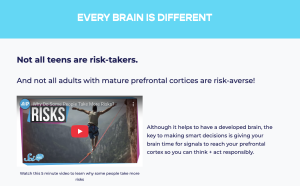
Not all teens are risk-takers. And not all adults with mature prefrontal cortices are not!
It’s a broad spectrum. Although it helps to have a developed brain, making smart choices is more about giving yourself time to make responsible decisions.
Watch this 5 minute video from SciShow Psych to learn why some people take more risks than others.
Activity: Open the PDF link to the right for instructions on how to lead a class activity to get students brainstorming strategies for how to buy themselves time to make smart decisions: How to Hack Your Limbic System.
SUMMARY:
Until the brain finishes maturing, the limbic system is in the driver’s seat. This can be a great thing! It can also lead to impulsive or risky decision making. Apply the science behind how your brain makes decisions to make better ones. The key is giving all of the parts of your brain enough time to act.
LET'S TALK ABOUT IT
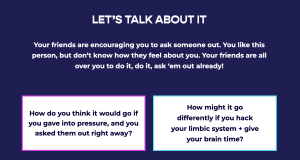
Your friends are encouraging you to ask someone out. You like this person, but don’t know how they feel about you. Your friends are all over you to do it! do it! ask ‘em out already!
- How do you think it would go if you gave into pressure you asked them out right away?
- Would it go differently if you hacked your limbic system?